Примечание
Перейти в конец чтобы скачать полный пример кода или запустить этот пример в браузере через JupyterLite или Binder.
Построение многоклассового SGD на наборе данных iris#
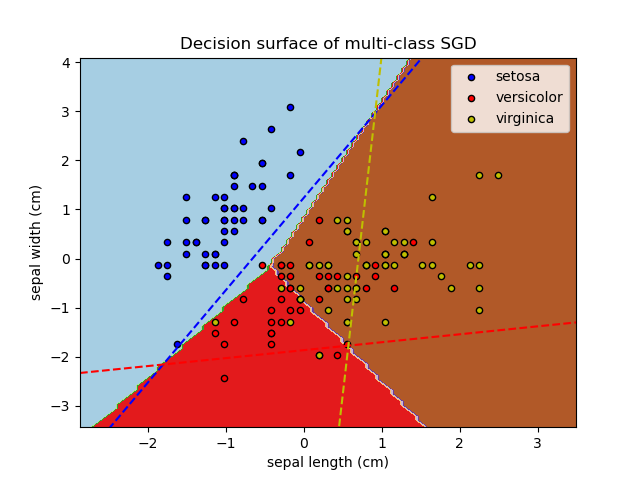
Построить поверхность решений многоклассового SGD на наборе данных iris. Гиперплоскости, соответствующие трём классификаторам один-против-всех (OVA), представлены пунктирными линиями.
# Authors: The scikit-learn developers
# SPDX-License-Identifier: BSD-3-Clause

import matplotlib.pyplot as plt
import numpy as np

from sklearn import datasets
from sklearn.inspection import DecisionBoundaryDisplay
from sklearn.linear_model import SGDClassifier

# import some data to play with
iris = datasets.load_iris()

# we only take the first two features. We could
# avoid this ugly slicing by using a two-dim dataset
X = iris.data[:, :2]
y = iris.target
colors = "bry"

# shuffle
idx = np.arange(X.shape[0])
np.random.seed(13)
np.random.shuffle(idx)
X = X[idx]
y = y[idx]

# standardize
mean = X.mean(axis=0)
std = X.std(axis=0)
X = (X - mean) / std

clf = SGDClassifier(alpha=0.001, max_iter=100).fit(X, y)
ax = plt.gca()
DecisionBoundaryDisplay.from_estimator(
    clf,
    X,
    cmap=plt.cm.Paired,
    ax=ax,
    response_method="predict",
    xlabel=iris.feature_names[0],
    ylabel=iris.feature_names[1],
)
plt.axis("tight")

# Plot also the training points
for i, color in zip(clf.classes_, colors):
    idx = (y == i).nonzero()
    plt.scatter(
        X[idx, 0],
        X[idx, 1],
        c=color,
        label=iris.target_names[i],
        edgecolor="black",
        s=20,
    )
plt.title("Decision surface of multi-class SGD")
plt.axis("tight")

# Plot the three one-against-all classifiers
xmin, xmax = plt.xlim()
ymin, ymax = plt.ylim()
coef = clf.coef_
intercept = clf.intercept_


def plot_hyperplane(c, color):
    def line(x0):
        return (-(x0 * coef[c, 0]) - intercept[c]) / coef[c, 1]

    plt.plot([xmin, xmax], [line(xmin), line(xmax)], ls="--", color=color)


for i, color in zip(clf.classes_, colors):
    plot_hyperplane(i, color)
plt.legend()
plt.show()
Общее время выполнения скрипта: (0 минут 0.092 секунды)


Связанные примеры
Построить поверхность решений деревьев решений, обученных на наборе данных ирисов
Построить поверхность решений деревьев решений, обученных на наборе данных ирисов
Анализ главных компонент (PCA) на наборе данных Iris
Анализ главных компонент (PCA) на наборе данных Iris