Примечание
Перейти в конец чтобы скачать полный пример кода или запустить этот пример в браузере через JupyterLite или Binder.
Удаление шума изображений с использованием обучения словаря#
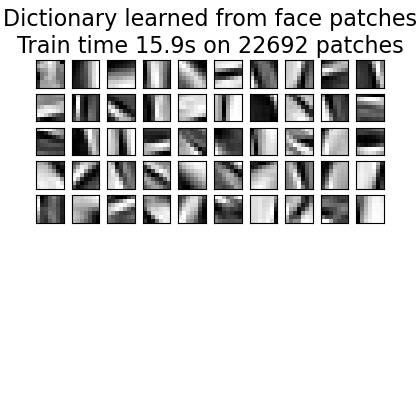
Пример, сравнивающий эффект восстановления зашумлённых фрагментов изображения лица енота с использованием сначала онлайн Словарное обучение и различные методы преобразования.
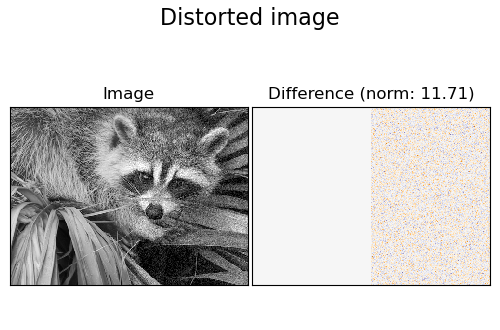
Словарь обучается на искаженной левой половине изображения и затем используется для восстановления правой половины. Обратите внимание, что даже лучшая производительность может быть достигнута при обучении на неискаженном (т.е. без шума) изображении, но здесь мы исходим из предположения, что оно недоступно.
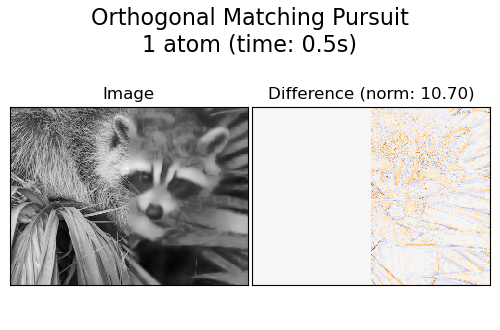
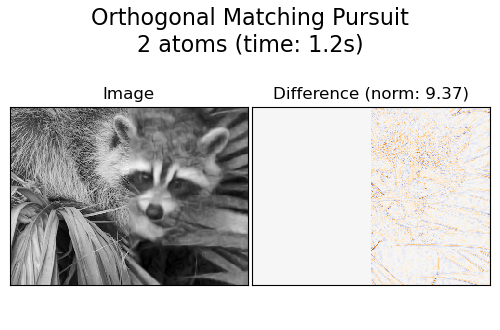
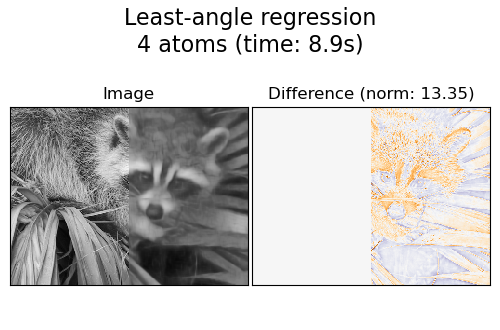
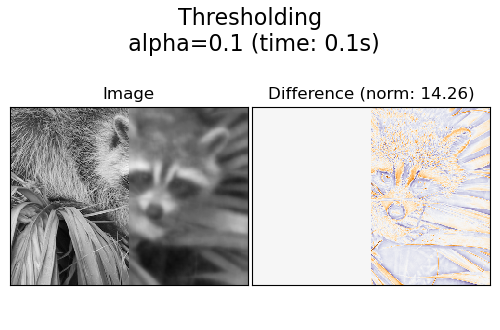
Распространённой практикой для оценки результатов шумоподавления изображений является анализ разницы между восстановленным и исходным изображением. Если восстановление идеально, это будет выглядеть как гауссов шум.
Из графиков видно, что результаты Ортогональное согласованное преследование (OMP) с двумя ненулевыми коэффициентами немного менее смещено, чем при сохранении только одного (края выглядят менее выраженными). Кроме того, оно ближе к истинному значению по норме Фробениуса.
Результат Least Angle Regression сильно смещена: разница напоминает значение локальной интенсивности исходного изображения.
Пороговая обработка явно не полезна для шумоподавления, но здесь она приведена, чтобы показать, что она может давать наводящий на размышления результат с очень высокой скоростью и, таким образом, быть полезной для других задач, таких как классификация объектов, где производительность не обязательно связана с визуализацией.
# Authors: The scikit-learn developers
# SPDX-License-Identifier: BSD-3-Clause
Сгенерировать искаженное изображение#
import numpy as np
from scipy.datasets import face

raccoon_face = face(gray=True)

# Convert from uint8 representation with values between 0 and 255 to
# a floating point representation with values between 0 and 1.
raccoon_face = raccoon_face / 255.0

# downsample for higher speed
raccoon_face = (
    raccoon_face[::4, ::4]
    + raccoon_face[1::4, ::4]
    + raccoon_face[::4, 1::4]
    + raccoon_face[1::4, 1::4]
)
raccoon_face /= 4.0
height, width = raccoon_face.shape

# Distort the right half of the image
print("Distorting image...")
distorted = raccoon_face.copy()
distorted[:, width // 2 :] += 0.075 * np.random.randn(height, width // 2)
Distorting image...
Отобразить искаженное изображение#
import matplotlib.pyplot as plt


def show_with_diff(image, reference, title):
    """Helper function to display denoising"""
    plt.figure(figsize=(5, 3.3))
    plt.subplot(1, 2, 1)
    plt.title("Image")
    plt.imshow(image, vmin=0, vmax=1, cmap=plt.cm.gray, interpolation="nearest")
    plt.xticks(())
    plt.yticks(())
    plt.subplot(1, 2, 2)
    difference = image - reference

    plt.title("Difference (norm: %.2f)" % np.sqrt(np.sum(difference**2)))
    plt.imshow(
        difference, vmin=-0.5, vmax=0.5, cmap=plt.cm.PuOr, interpolation="nearest"
    )
    plt.xticks(())
    plt.yticks(())
    plt.suptitle(title, size=16)
    plt.subplots_adjust(0.02, 0.02, 0.98, 0.79, 0.02, 0.2)


show_with_diff(distorted, raccoon_face, "Distorted image")
Извлечение референсных патчей#
from time import time

from sklearn.feature_extraction.image import extract_patches_2d

# Extract all reference patches from the left half of the image
print("Extracting reference patches...")
t0 = time()
patch_size = (7, 7)
data = extract_patches_2d(distorted[:, : width // 2], patch_size)
data = data.reshape(data.shape[0], -1)
data -= np.mean(data, axis=0)
data /= np.std(data, axis=0)
print(f"{data.shape[0]} patches extracted in %.2fs." % (time() - t0))
Extracting reference patches...
22692 patches extracted in 0.01s.
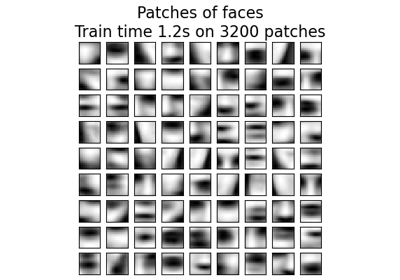
Изучить словарь из эталонных патчей#
from sklearn.decomposition import MiniBatchDictionaryLearning

print("Learning the dictionary...")
t0 = time()
dico = MiniBatchDictionaryLearning(
    # increase to 300 for higher quality results at the cost of slower
    # training times.
    n_components=50,
    batch_size=200,
    alpha=1.0,
    max_iter=10,
)
V = dico.fit(data).components_
dt = time() - t0
print(f"{dico.n_iter_} iterations / {dico.n_steps_} steps in {dt:.2f}.")

plt.figure(figsize=(4.2, 4))
for i, comp in enumerate(V[:100]):
    plt.subplot(10, 10, i + 1)
    plt.imshow(comp.reshape(patch_size), cmap=plt.cm.gray_r, interpolation="nearest")
    plt.xticks(())
    plt.yticks(())
plt.suptitle(
    "Dictionary learned from face patches\n"
    + "Train time %.1fs on %d patches" % (dt, len(data)),
    fontsize=16,
)
plt.subplots_adjust(0.08, 0.02, 0.92, 0.85, 0.08, 0.23)
Learning the dictionary...
2.0 iterations / 125 steps in 15.87.
Извлечь зашумленные патчи и восстановить их с использованием словаря#
from sklearn.feature_extraction.image import reconstruct_from_patches_2d

print("Extracting noisy patches... ")
t0 = time()
data = extract_patches_2d(distorted[:, width // 2 :], patch_size)
data = data.reshape(data.shape[0], -1)
intercept = np.mean(data, axis=0)
data -= intercept
print("done in %.2fs." % (time() - t0))

transform_algorithms = [
    ("Orthogonal Matching Pursuit\n1 atom", "omp", {"transform_n_nonzero_coefs": 1}),
    ("Orthogonal Matching Pursuit\n2 atoms", "omp", {"transform_n_nonzero_coefs": 2}),
    ("Least-angle regression\n4 atoms", "lars", {"transform_n_nonzero_coefs": 4}),
    ("Thresholding\n alpha=0.1", "threshold", {"transform_alpha": 0.1}),
]

reconstructions = {}
for title, transform_algorithm, kwargs in transform_algorithms:
    print(title + "...")
    reconstructions[title] = raccoon_face.copy()
    t0 = time()
    dico.set_params(transform_algorithm=transform_algorithm, **kwargs)
    code = dico.transform(data)
    patches = np.dot(code, V)

    patches += intercept
    patches = patches.reshape(len(data), *patch_size)
    if transform_algorithm == "threshold":
        patches -= patches.min()
        patches /= patches.max()
    reconstructions[title][:, width // 2 :] = reconstruct_from_patches_2d(
        patches, (height, width // 2)
    )
    dt = time() - t0
    print("done in %.2fs." % dt)
    show_with_diff(reconstructions[title], raccoon_face, title + " (time: %.1fs)" % dt)

plt.show()
Extracting noisy patches...
done in 0.00s.
Orthogonal Matching Pursuit
1 atom...
done in 0.51s.
Orthogonal Matching Pursuit
2 atoms...
done in 1.19s.
Least-angle regression
4 atoms...
done in 8.94s.
Thresholding
 alpha=0.1...
done in 0.11s.
Общее время выполнения скрипта: (0 минут 27.506 секунд)


Связанные примеры
Сегментация изображения греческих монет на регионы